The Mounting Layer: Why Bracket and Fastener Choice Decides Whether a Scaffold Alarm Survives the Night

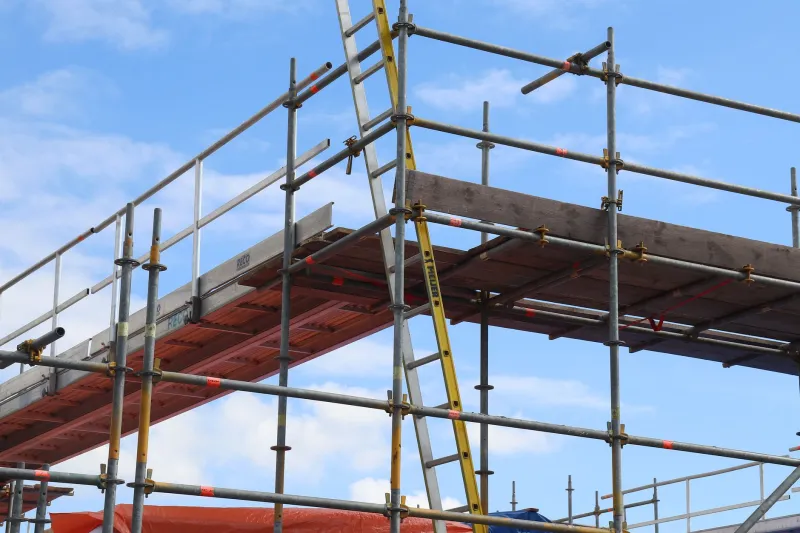
Photo: Kuhlmann /MSC, CC BY 3.0 de, via Wikimedia Commons
The fixing is the first tamper zone
On a UK scaffold, an alarm enclosure is rarely attacked through its electronics. The more common route is physical: a lever behind the box, a cut cable tie, a removed screw, a bracket prised off a tube. Once the mounting layer fails, the alarm is either gone or disabled before it can report anything useful. Yet mounting hardware is often treated as an accessory rather than a security control. Specifiers who would never accept an unspecified sensor will frequently accept whatever bracket arrived in the box.
That asymmetry deserves attention in 2026. The threat on live UK sites is not only opportunistic; organised removal of temporary security equipment is a recognised pattern. The mounting layer should therefore be designed to delay removal, resist casual interference and, where possible, signal tampering before the enclosure leaves the scaffold.
Bracket selection: scaffold tube is not a universal fixing surface
Scaffold alarms are commonly mounted to standard 48.3 mm tube. The bracket must suit that surface without drilling the tube or relying on friction alone. Proprietary clamps and couplers are preferable to plastic ties or universal straps because they provide a mechanical grip that can be inspected and re-torqued. A single-point clamp allows rotation; a two-point fixing, or a bracket with an anti-rotation key, is more resistant to levering.
Where an alarm is mounted close to a building face, avoid transferring load into the fabric unless the specification explicitly permits it. Heritage and conservation sites may prohibit penetration, and even on ordinary projects a bracket that depends on a wall plug introduces a weak point that is difficult to inspect once the scaffold is sheeted. The scaffold tube should carry the alarm; the building should not be asked to do so informally.
Security fasteners raise time and noise, not invincibility
Standard hex bolts and cross-head screws are removable with tools carried in a pocket. Security fasteners — Torx pin, snake-eye, one-way or shear-nut patterns — increase the time and noise required to remove an enclosure. They are not a guarantee, but they change the economics of an attack. Specify stainless steel A2 or A4 fasteners where corrosion is likely, particularly on coastal or industrial sites, and avoid mixing stainless fasteners with galvanised brackets without considering galvanic effects.
Thread-locking compound can reduce vibration loosening, but it complicates maintenance. A nylon-insert nut or a serrated flange nut may be a better compromise where the alarm must be serviced during the build. The key control that accompanies security fasteners should be recorded in the same way as alarm fobs: one key, one named holder, and a log of issue and return. A security screw is only as good as the discipline around its driver bit.
Enclosure ratings: IP is necessary but not sufficient
An IP65 or IP66 enclosure is a sensible baseline for UK weather, but the IP rating does not describe impact resistance, UV stability or resistance to site chemicals. On a scaffold, an alarm box may be struck by materials, clipped by plant or exposed to prolonged sunlight. A UV-stabilised polycarbonate or GRP enclosure with a defined IK impact rating is more defensible than a generic IP-rated box.
Cable entries are part of the mounting layer. Every gland is a potential water path, and every drilled hole is a potential crack initiator. Specify sealed glands, drain loops and replaceable gaskets. If the enclosure is opened for commissioning and not re-sealed correctly, the IP rating is lost. The handover file should record the gland type and the date of the last seal inspection.
Wind loading and vibration
Exposed elevations and sheeted scaffolds create wind loads that a small enclosure may not appear to attract, but the bracket and fasteners see repeated vibration as well as steady pressure. A cantilever bracket amplifies both. Keep the centre of mass close to the tube, use a bracket with a positive stop against rotation and check the manufacturer’s wind-load guidance against the site exposure category. For tall or exposed scaffolds, a structural check using BS EN 1991-1-4 principles is prudent even for temporary equipment.
Vibration from plant, hoists and adjacent works can loosen fasteners over weeks. Nylon-insert nuts, thread-locking washers or a defined re-torque interval are practical controls. The inspection regime should include the bracket, not just the battery and sensor.
Tamper detection at the mounting layer
Tamper detection is often limited to an enclosure-opening switch. That misses the more likely attack: removing the whole box from its bracket. A magnetic reed switch between bracket and enclosure, or a microswitch on the clamp, can report removal. Accelerometer-based tamper detection can identify levering or cutting, but it must be tuned to avoid nuisance alarms from wind and site vibration. Where tampering is detected, the signal should be reported as a distinct mounting-tamper event, not folded into a general intrusion zone. That distinction matters for response and for the evidence trail.
Specification and handover
The mounting layer should be scheduled, not improvised. A simple schedule can record bracket type, fastener pattern, torque setting, enclosure rating, tamper device and inspection interval. At handover, include the bracket manufacturer’s data, the fastener key codes and a photograph of each installed mounting point. At dismantle, recover security fasteners and keys and audit any missing items. This is basic asset control, but it is often omitted because mounting is seen as a minor installation detail.
Conclusion
A scaffold alarm is a system, and the fixing is part of that system. Bracket selection, security fasteners, enclosure ratings, wind loading and tamper detection are not separate accessories; they are the physical layer that determines whether the electronic layer can do its job. In 2026, with temporary equipment under sustained theft pressure, specifying the mounting layer as a security control is not over-engineering. It is the difference between an alarm that reports an attack and one that disappears with the scaffold.