Weather-Proof Detection: Reducing False Activations on Exposed UK Scaffolds
Photo: Marathon , CC BY-SA 2.0, via Wikimedia Commons
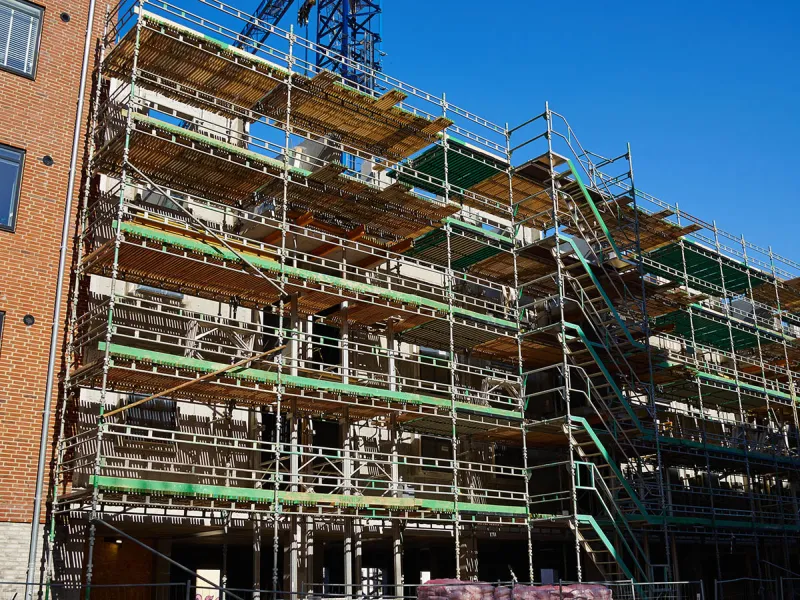
On exposed UK scaffolds, false alarms are not merely an administrative inconvenience. They consume key-holder time, undermine confidence in the system and, over time, train responders to treat every activation as probable nuisance. That is a security weakness. Weather resilience therefore belongs in the alarm design, alongside zoning and detector coverage.
Why Weather-Driven Nuisance Alarms Matter
A scaffold alarm that activates repeatedly in high wind or heavy rain creates a predictable pattern of callouts. Key-holders become slower to respond. Site managers begin to question the value of the system. In some cases, genuine intrusion events are dismissed as "another weather alarm". The result is a system that is technically active but operationally weak.
The cost is not only the callout charge. There is the lost working time, the disruption to neighbours, the potential for damaged access equipment and the erosion of the response plan. Weather tuning is therefore a security control, not a maintenance preference.
Sensor Selection for Exposed Elevations
Detector choice should reflect the environment. Passive infrared detection alone can be troubled by rapid thermal changes, rain-cooled surfaces and moving debris. On exposed scaffolds, dual-technology detection combining PIR with microwave or another confirmatory technology is often more stable, because activation requires agreement between two different sensing principles.
Housing protection also matters. Detectors should be rated for the exposure they will face, with appropriate ingress protection and a stated operating temperature range. Bracketry should be rigid enough to prevent movement in gusting wind, and cable entries should be sealed against driven rain.
Placement and Zoning
Many weather false alarms originate from placement rather than from the detector itself. Units mounted where they face open sky, catch direct rain, or view loose sheeting and debris are more likely to nuisance. Corner positions on exposed elevations can be particularly problematic because they concentrate wind-driven movement.
A more stable approach is to mount detectors under shelter where the scaffold geometry allows, with a view of the access route rather than the full elevation. Zoning should follow the faces and access points that matter, not simply blanket the scaffold. Detection should be concentrated where an intruder would need to pass, climb or remove material.
Environmental Filtering and Activation Thresholds
Most modern panels and detectors offer some form of environmental filtering: pulse counting, sensitivity adjustment, confirmation timers or dual-technology coincidence. These should be used deliberately. Too little filtering produces nuisance activations; too much can delay or suppress genuine detection.
The correct setting is site-specific. A short confirmation period may be appropriate where the risk is opportunistic access from a public footpath. A longer confirmation or dual-technology requirement may suit an exposed face where wind movement is predictable. The setting should be recorded, justified and reviewed after weather events rather than changed informally.
Remote Verification and Callout Economics
Remote verification can reduce unnecessary attendance. Sequential confirmation, where a second detector must operate within a defined period, can distinguish a person moving through the scaffold from a single detector reacting to weather. Where monitoring is provided, the receiving centre should understand the site layout and the weather-sensitive zones.
It is worth calculating the real cost of a callout: key-holder time, travel, site attendance, lost sleep and the administrative burden of repeated incidents. A modest investment in better placement or dual-technology detection is often cheaper than a winter of avoidable activations.
Commissioning and Seasonal Review
Commissioning should include a weather review. Check that detectors are secure, cable entries are sealed and drainage does not direct water onto housings. Confirm that battery and communications status are monitored, because cold weather can affect both.
After periods of high wind or driving rain, review the event log for patterns. Are activations concentrated on one face? Do they occur at particular wind directions? Are they associated with loose sheeting or scaffold wrap? The log should inform adjustment, not just record nuisance.
Specification Checklist
- Select detectors suited to exposed external use, with stated ingress protection and temperature range.
- Prefer dual-technology detection on weather-sensitive elevations.
- Mount securely, sheltered where possible, away from loose sheeting and direct rain.
- Zone by access route and vulnerable face rather than blanket coverage.
- Record sensitivity, pulse count and confirmation settings at handover.
- Verify remotely where monitoring arrangements allow.
- Review event logs after severe weather and adjust with justification.
Conclusion
Weather resilience is not about removing detection. It is about making detection credible in the conditions the scaffold will actually face. A well-tuned system distinguishes between wind and a person, between rain and a breach. That distinction protects the response plan and preserves the alarm's value as a genuine security measure.